Charlie (also known as Bear) is eight years old and weighs 33 pounds. He has pontocerebellar hypoplasia type 2, causing a global developmental delay and generalized low tone, limited head control, and upper limb function. He also has a visual impairment and is on a plow PEG feed. Although non-verbal, Charlie has no difficulty in communicating his feelings – he is very affectionate, loves cuddles, and likes being the center of attention.
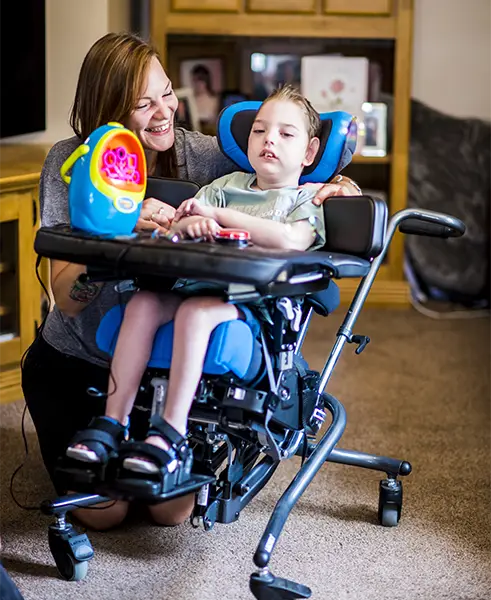
Due to Charlie's small frame and complex needs, it has been difficult to find a suitable seat for him. His previous seat was often significantly tilted to allow gravity to assist with positioning, but Charlie finds this restrictive as he loves exploring the environment with his eyes. When positioned upright, he tends to slide forward, hunch over, and drop his head.
Goal Setting
The primary goal identified by Charlie's therapist was to improve his posture in the classroom. This would then allow him to use a switch, participate in circle time, and interact with his friends. For his family, the main goal identified was a comfortable and supportive seat to relax and look around.
Assessment
The mat assessment identified that Charlie had a full range of movement with no limitations in pelvic, lower limb, or spinal movements. His low tone causes hip flexion, abduction, and external rotation in supine. His left hip is subluxated causing a leg length difference of under 2cm when seated. When seated upright, the low tone caused his trunk to collapse down and he required firm control at his pelvis, trunk, and shoulders to maintain a neutral upright posture. With a high level of support, Charlie can keep his head in midline and control eye movements with just minor seat tilt.
Set Up
It was agreed that Charlie would benefit from a seat that would maintain pelvic stability and control excessive hip abduction & forward sliding. In addition, a backrest offering tailored posterior and lateral support was required to maintain upright trunk position. The Leckey BeMe contoured cushion, moderate backrest, and a tilt-in-space chassis were selected.
How the BeMe contoured cushion met Charlie's needs
- Hip width (ischial well width): The soft contoured support provided lateral stability and removed the need for firm hip guides against the subluxated hip.
- Ischial well depth: The pre-ischial shelf was positioned just anterior to the ischial tuberosities to prevent forward sliding.
- Femoral wells: Individual femoral guides, with integrated pommel, served to slightly abduct and externally rotate Charlie's legs. This is in line with recognized positioning guidelines for hip health. The minor leg length difference was not an issue.
Setting up the moderate back support
- Headrest: Charlie benefitted from the adjustable wings on the contoured headrest to distribute pressure and prevent his head from falling to the side.
- Shoulder: The anterior tilt insert brought the shoulder section forward to maximize contact with Charlie's upper back.
- Thoracic: The wraparound lateral stabilized the trunk by providing both lateral and anterior support.
- Sacral: Slight anterior tilt encouraged a neutral pelvis and upright posture.
Maximizing Upper Limb Function and Head Control
As Charlie loves hugs and deep pressure, he responded well to the proprioceptive input of the BeMe wraparound lateral. Locating the wraps over his PEG site caused no issues while still allowing full range of movement of his upper limbs.
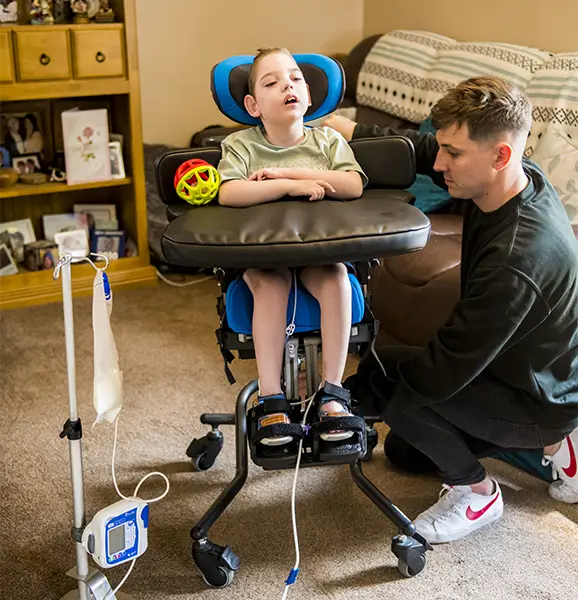
The tray was set high, enabling Charlie to prop his arms up and bring support to his shoulder girdle and head. When increased anterior support is required, the wraparound lateral can be easily folded away and replaced with a butterfly harness (not pictured).
Charlie's arms naturally come to midline, so shoulder wings were not required. However, elbow blockers were helpful in preventing the arms falling back during periods of relaxation / maximum tilt.
Review
Charlie was reviewed after several weeks to see if the seat met his needs. His therapist was particularly happy that he no longer sat in the fetal position and has achieved the best seated posture to date.
Despite being more upright than before, Charlie has found the position relaxing and has particularly benefited from the wraparound lateral and large contoured head support. He is currently working on switch control and the functional position he can achieve with the BeMe will greatly assist him.