Imteyaz is a lively and spirited 10-year-old girl who lives at home with her mom, dad, and siblings. Over the last 18 months, Imteyaz has been unable to tolerate any form of sitting. If she is in a seat for more than 10 minutes, she becomes very unsettled and distressed. While Imteyaz loves to stand, her inability to tolerate sitting means that she spends most of her day side-lying at home or at school. This limits Imteyaz's ability to engage in classroom activities like circle time, music, and sensory group sessions. She finds it upsetting to not be at eye level to engage with her peers and is frustrated that she cannot recognize the origin of sounds and stimuli.
Imteyaz has a diagnosis of mixed quadripegic cerebral palsy (spastic and dystonic). Her dystonia can cause a corkscrew-like movement where she will twist her spine and extender herself up and to the right. In previous seating systems, these movements would leave her poorly positioned and uncomfortable. She is PEG-fed, but has a history of difficulty keeping food down, which is likely compounded by her inability to stand or sit upright for sustained periods.
Goal Setting
Imteyaz's family and her therapist, Ellie, identified one clear goal: to improve her sitting tolerance so that she could engage in classroom and home activities and not spend most of her day side-lying. In addition, a secondary goal was set to prevent further postural deterioration, particularly at her spine.
Assessment
Imteyaz's postural presentation and needs were determined by a plinth assessment in supine and sitting.
In supine, she presents with a pelvic obliquity (right side higher) and a pelvic rotation (left side forward), both of which are partially correctable. Imteyaz's legs are also windswept to the right-hand side – her right leg is fixed in externatal rotation and abduction, and her left leg in internal rotation and adduction. Imteyaz has no limitations hip or knee flexion bilaterally.
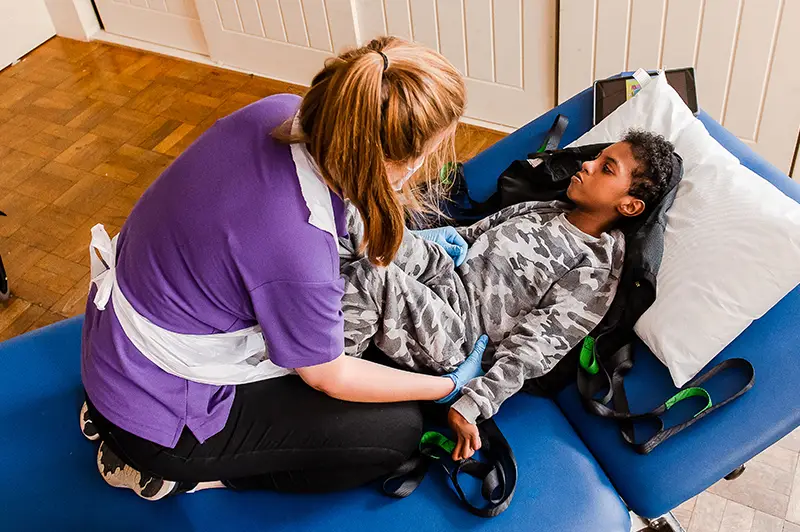 Ellie manipulating Imteyaz's pelvis. Notice how the thumbs are not level due to the obliquity.
Pelvic rotation and windsweeping
When Imteyaz's head and shoulders are positioned facing forward, her spinal twist causes the pelvis to be rotated forward on the left-hand side and her legs are windswept to the right-hand side.
Moving Imteyaz's legs into midline causes the pelvis to rotate forward on the right, and the head & trunk to rotate into a very non-functional position.
A setup is required which allows some degree of windsweeping to ensure the head and trunk face forward.
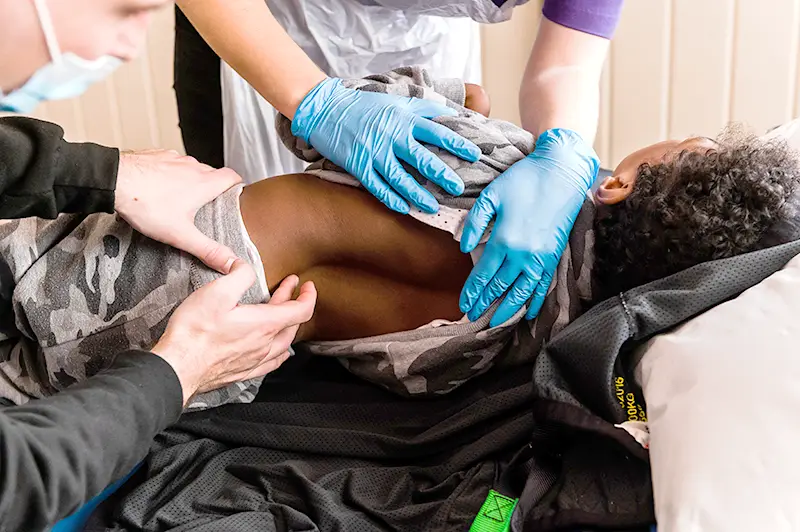 A side lying position helps understand Imteyaz's spine. Notice the S-shaped concavity in her back. Normally, as gravity is pressing down on the body, the spine would level out. This demonstrates how Imteyaz's scoliosis is partially fixed.
In a seated position on the plinth, Ellie was able to determine the effect that gravity has on Imteyaz's posture and how it affects her trunk and head control. This position is also ideal to help determine magnitude and direction of support required to reduce Imteyaz's partially correctable scoliosis.
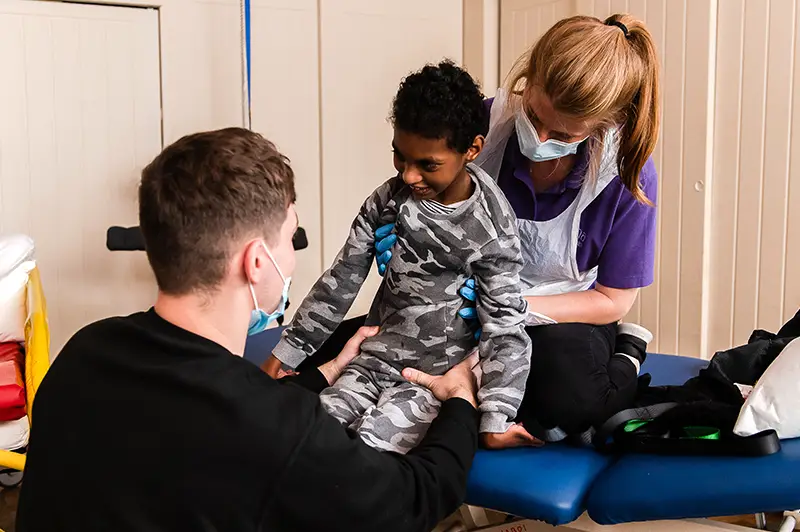 Notice how tall and upright Imteyaz becomes when 3-point loading principles are used to support the pelvis and spine: Head control, visual tracking, and upper limb position are all improved.
Pelvic obliquity and scoliosis
Imteyaz's pelvic obliquity and scoliosis without support. Her pelvis is higher on the right-hand side and the scoliosis is concave on the right-hand side at lumbar level.
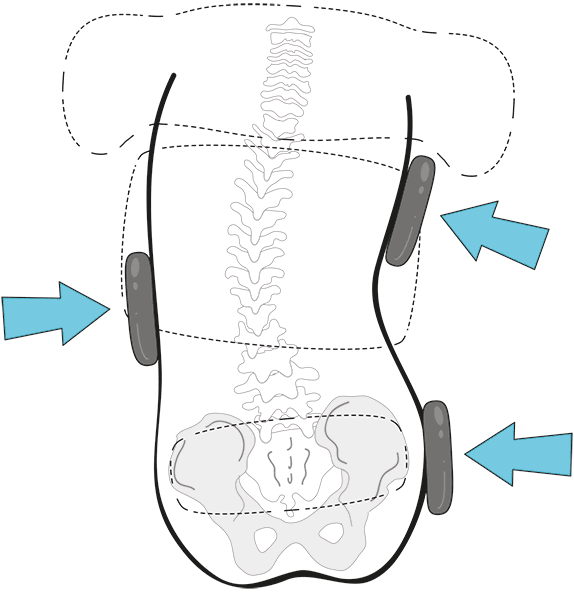
3-point loading along her spine partially straightens the scoliosis, helping to level the pelvis and open out the thoracic cavity.
Setup
To accommodate Imteyaz's windswept posture, fixed pelvic rotation, and obliquity, a split seat base and complex backrest were selected. The complex backrest allows depth and rotational adjustment at the sacral segment to accommodate her fixed rotation. In addition, both the thoracic and shoulder sections can be angled and depth-adjusted to ensure maximum contact and support with her spine.
Setting up the complex backrest
- Shoulder: Minor rotation was used to accommodate the remaining spinal twist and scoliosis. Depth adjustment enabled maximum contact with her shoulders. The wings were protracted slightly to help maintain Imteyaz's arms in midline and control her dystonic movements.
- Thoracic: 3-point loading principles (right lateral higher than left) were used to reduce the scoliosis. Hinged lateral pads increased the support area and improved control of dystonic movements.
- Sacral: The sacral pad was rotated to accommodate the minor fixed pelvic obliquity. The unique sacral-to-thoracic transitional part supported her natural lumbar lordosis and encouraged an upright posture.
- Split seat: The leg supports were windswept to the right, which enabled Imteyaz's head and trunk to face forward. The femoral gables controlled the tight left leg and ensured there was adequate space between the femurs for hygiene purposes. Individual footplates helped control foot position with sandals that could accommodate AFOs.
Review
Following a period of use both at school and at home, Imteyaz's progress with the Leckey BeMe was reviewed.
At school: Imteyaz has significantly benefited from the BeMe. She can now tolerate sitting for over an hour before being repositioned in her standing frame and she is now less reliant on side-lying for comfort. As a result, Imteyaz can engage in classroom activities, such as circle and music time. Being at eye level with staff and her peers has enabled her to gain a better understanding of her environment and she shows little distress. This is the first time in a long time that Imteyaz has been able to engage in classwork.
At home: Mom, Dad, and Imteyaz's older sister are delighted with her new seat. Her sister commented, "I like this chair because it lets my sister sit with her legs to the side and that's the way she likes to sit." Imteyaz no longer spends her days at home on the sofa and is now in a position to interact with her family and friends.
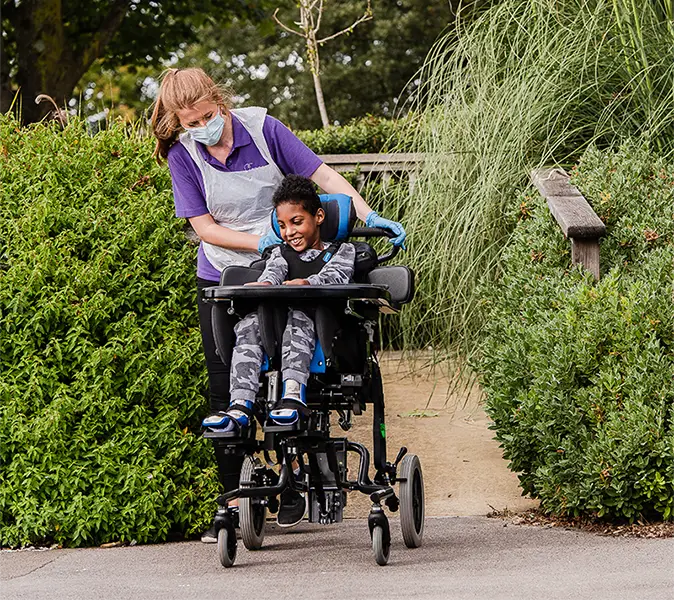
Imteyaz's therapist, Ellie, is very pleased with how Imteyaz has responded to the BeMe particuarly, as for the first time in a long time she can tolerate a seated upright posture. Imteyaz's digestion appears to have improved and she can engage in functional activities at home and in school. Ellie has commented how beneficial the seat has been to control Imteyaz's dystonic movements, noting that the combination of supports helps return her to an optimal position.