Grace, at 18 years old, shares the typical interests of many young girls: partying, getting dressed up, and in her case, a particular affection for Shawn Mendes. She loves to perform, be it on stage or on YouTube, and has tens of thousands of followers across various social media platforms.
Grace has quadriplegic cerebral palsy, but is determined that it won't stop her from enjoying herself. How cerebral palsy impacts Grace is extraordinary. She is able to go up and down stairs, walk for reasonable periods of time (with a scissor gait pattern), and can text incredibly fast. She, however, particularly struggles with maintaining a functional upright posture in a seated position. This makes everyday tasks like feeding, brushing her teeth, or Mom applying her makeup, quite difficult.
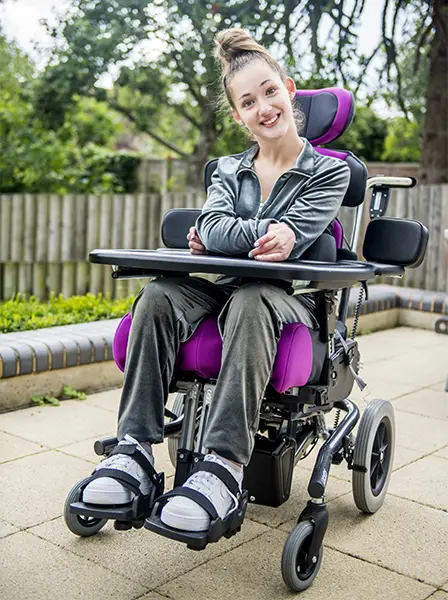
Grace is predominately affected on her left side. In sitting, she internally rotates her left shoulder, extends her left arm out, and hyperextends her neck upwards and to the left. This often results in Grace catching her head between the seat's headrest and backrest.
Goal Setting
On meeting Grace, it was important to define clear goals of how the Leckey BeMe could help her with everyday activities. Grace and her mom, Simone, identified the following goals:
- Grace to be as independent as possible with feeding – Grace has an assistive eating device at home, but is unable to use this as she is insufficiently supported.
- Effective support to inhibit uncontrolled movements – beneficial for both feeding and for when Mom helps Grace put on her makeup.
- Grace to use the seat for other tasks (e.g., when she watches television at home). This is to discourage her from sitting in destructive postures for extended periods of time.
- A seat which facilitates safe assisted standing transfers.
Assessment
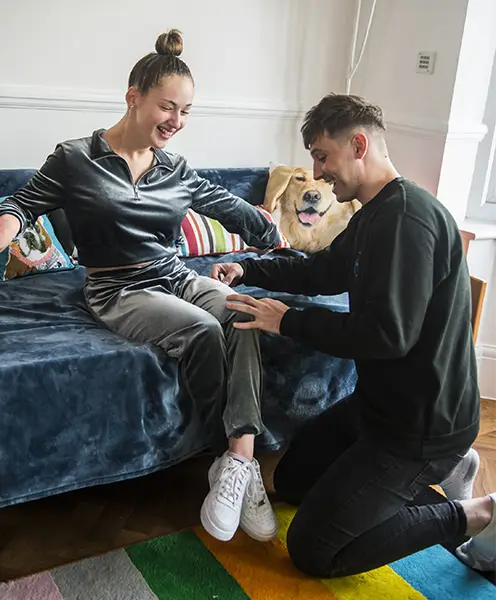
A mat assessment identified that Grace had no limitations in hip, knee, or ankle mobility. Her hips tend to come into adduction and slight external rotation, causing her feet to cross. Due to low tone, Grace has a tendency to slide into posterior pelvic tilt, causing her trunk to collapse and thus firm pelvic and lumbar supports are required to maintain an upright posture. Her spine, although demonstrating a minor scoliosis (concave right), was correctable with moderate external support.
Setup
Pelvis and lower limb
To enable standing transfers and provide effective support to discourage hip adduction, either the basic seat (with integral pommel and hip guides) or the contoured seat were deemed as suitable options.
Basic seat base
Pros
- Supported standing transfers
- Maintained pelvis in neutral alignment
- Pommel prevented hip adduction
Cons
- Grace preferred lateral support / comfort of contoured cushion over hip guides
Contoured seat base
Pros
- Maintained pelvis in neutral alignment
- Removed necessity of hip guides and pommel
- Cushion femoral wells maintained slight hip abduction
- Grace reported increased comfort and liked the feel of the cushion "molded to her bum shape"
Cons
- Standing transfers slightly impeded due to integrated pommel shaping
As both options were deemed suitable, a collaborative decision was taken to encourage Grace to increase chair use at home in line with her goals. Therefore, Grace requested to use the contoured cushion.
Setting up Grace's contoured cushion
- Hip width (ischial well width)
- Ischial well depth
- Thigh length (cushion depth)
Setting back support
- Trunk and head support: Grace requires firm trunk support to discourage kyphosis and correct scoliosis, with individualized support to improve arm function. To achieve this, a complex backrest was chosen to allow for both depth and rotational adjustment at each of its three segments.
- Shoulder segment: The shoulder wings were angled forwards to control shoulder rotation and help maintain Grace's arms in midline. Both depth and rotational adjustment was used to provide maximal contact.
- Thoracic: 3-point loading principles, with the right lateral higher than the left, were used to help correct the minor scoliosis.
- Sacral: To encourage an upright posture, the lowest segment was set in anterior tilt. By positioning it slightly higher than Grace's posterior superior iliac spine (PSIS), it not only kept the pelvis in neutral, but the foam insert (which joins the sacral and thoracic segments) created an arc which prompted natural lumbar lordosis.
Review
BeMe was reviewed after several weeks to check if it was meeting Grace and Mom's initial goals.
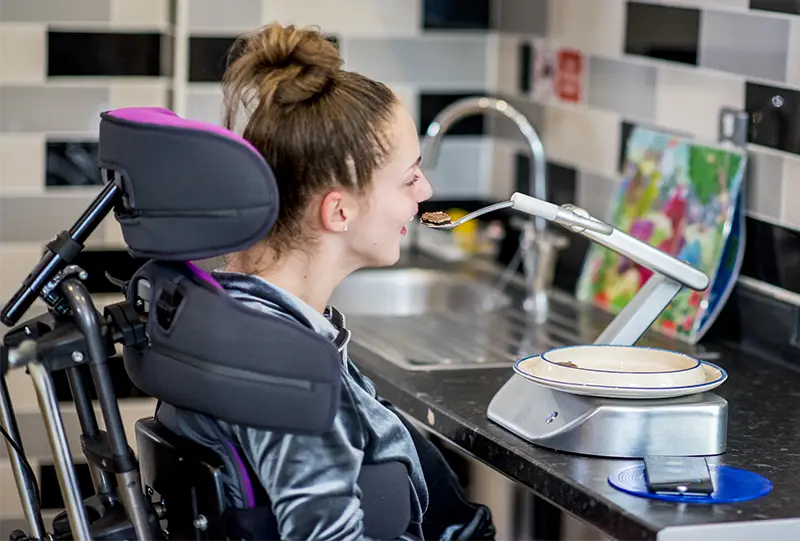
Mom reported an increased use of the seating system at home, something Grace had always struggled to tolerate. Grace was able to feed herself for much longer using her adaptive eating device, which will help promote independence as she gets older.
Another positive improvement was seen in her overall breathing. Grace explained, "Sometimes with my condition, I often forget to breathe and when I am sat on the couch hunched over, it can make my breathing difficult. When I use BeMe, my chest is opened up so I am able to breathe much easier." Grace also added that being able to maintain a good posture has meant a great improvement in her mom's makeup skills!