Akpeil is a bright, engaging 15-year-old girl with a great sense of humor and strong communication skills. She recently transitioned into residential care. While no formal diagnosis has been confirmed, her clinical presentation is consistent with quadriplegic spastic cerebral palsy. Prior to this move, Akpeil had very limited access to postural management or therapeutic intervention.
Her muscle tone is highly responsive to environmental stimuli such as laughter, uneven terrain, and emotional excitement – leading to abnormal movement patterns, loss of postural control, and discomfort.
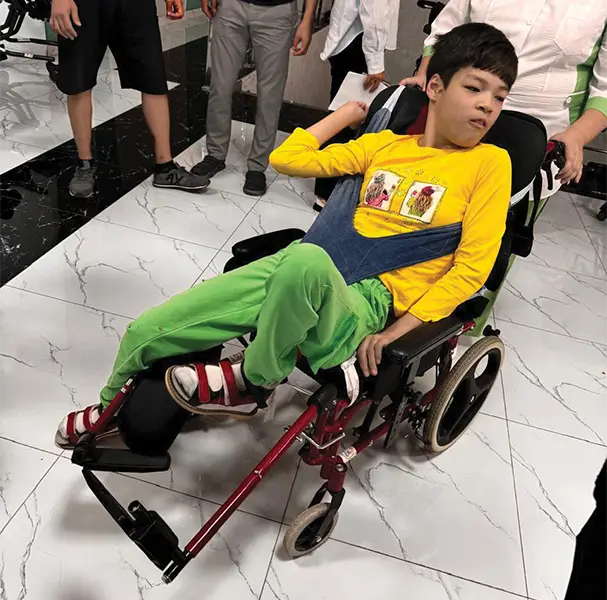
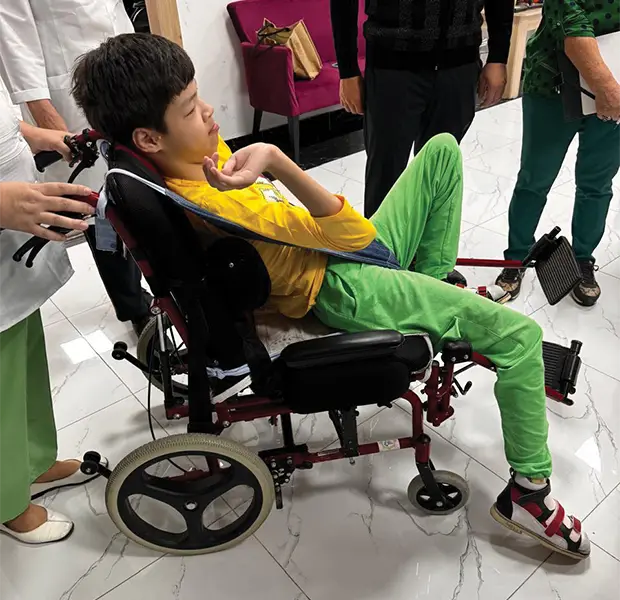
At her initial assessment, Akpeil arrived in a basic wheelchair with a solid backrest and fixed calf supports. A groin harness had been used to prevent her from sliding forward. However, this solution proved uncomfortable, undignified, and ineffective – it increased her muscle tone and failed to support a functional or sustainable seated posture.
Clinical Presentation and Assessment Findings
Spinal and trunk alignment
In supine, her right shoulder was unable to make full contact with the plinth, suggesting possible trunk rotation or kyphotic curvature. Side-lying assessment revealed a slight indentation, indicating a fixed lumbar rotation. Although clinical evaluation was complicated by her laughter during palpation, these findings supported the need for complex, three-dimensional back support.
Pelvic and spinal mobility
Akpeil displayed restricted pelvic movement in all three rotational planes, suggesting possible contractures in the lower lumbar spine.
Hip and knee range of motion
Hip flexion was limited to approximately 90° bilaterally. Since maintaining muscles at end range long-term can lead to secondary complications, an optimal seated hip angle of 80° was recommended. With hips flexed to 80°, knee extension – particularly on the right – was significantly reduced due to shortened hamstrings. Fixed calf supports were likely contributing to tension in the hamstrings which was pulling her forward. Individual footplates positioned behind the knees were advised to offload the hamstrings and support pelvic alignment.
Lower limb asymmetry
The right hip was fixed in 5° of adduction and approximately 10° of internal rotation. The left leg had limited movement but retained sufficient range for a functional posture, with 15° of abduction and external rotation possible.
Trunk control
Despite these asymmetries, Akpeil showed notable trunk control. Using the Segmental Assesment of Trunk Control (SATCo), she demonstrated active control at the upper lumbar level when pelvic support was provided – a key insight that informed equipment prescription.
Trial seating
A Leckey BeMe Moderate seating system was trialed during assessment. While it resulted in a visibly improved upright posture, it was concluded that a split seat base with femoral gables would offer better long-term stability and postural control.
BeMe Advanced Solution and Rationale
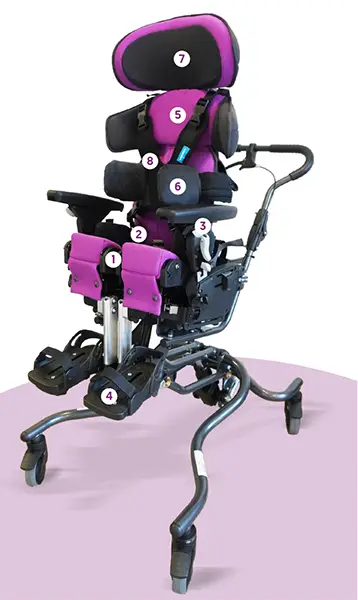
- Split seat base with femoral gables: Offers superior postural stability compared to a contoured seat alone. The split design allowed accommodation of her leg asymmetries and reduced spastic response during high tone.
- Four-point pelvic belt: Remove the groin harness and position a 4-point belt to maintain a neutral pelvis and prevent posterior tilt, thereby not compromising comfort or dignity.
- Seat-to-back angle: Opened to 80° to accommodate reduced hip flexion range, avoiding long-term positioning at end range.
- Individual footplates: Positioned behind the knees to offload tight hamstrings, especially on the right side.
- 3D Advanced backrest: Three independently adjustable segments to accommodate Akpeil's fixed spinal asymmetries. The sacral pad prompts lumbar extension to further reduce tone.
- Lateral supports: Positioned at equal heights to maintain midline trunk orientation and with protraction pads to prevent unwanted arm movements.
- Headrest and tray: Prescribed for rest periods and functional activities, respectively.
- Tray and chest harness: Anterior support is optional to encourage activity and preserver her choice and comfort.
Outcomes
Since receiving her BeMe Advanced seating system, Akpeil has shown significant imrpovements in posture, comfort, and engagement. The removal of the groin harness – replaced with a more respectful, biomechanically appropriate postural system – has enhanced her ability to maintain trunk alignment, even during periods of high tone or laughter.
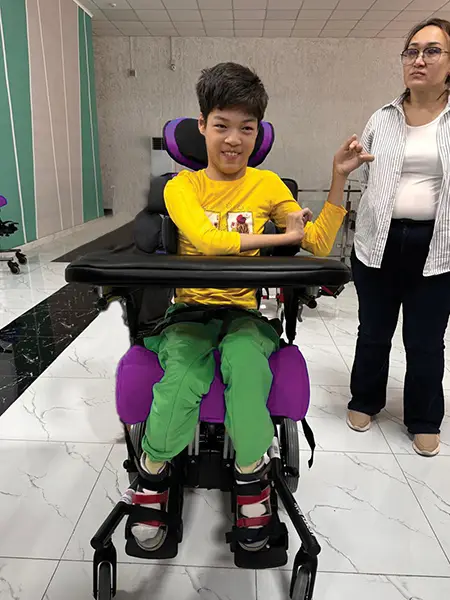
Staff at her residential care home report that she now spends longer periods comfortably in her chair, with reduced need for repositioning. Her upright posture has also contributed to decreased lower limb spasticity, further improving her seated tolerance and interaction with peers and caregivers.
Her BeMe not only supports her body, it support her confidence, dignity, and ability to thrive as a bright, sociable young person with the right interventions in place.