My son Andrew was only 15 months old when his physical therapist (PT) recommended a wheelchair for him. At the time, it was just another piece of equipment Andrew needed – a bath chair, a gait trainer, a specialized car seat – another tool to help him make any kind of progress in his development. There was a lot going on in those early years of Andrew's life. It was all so new. This difficult life of raising a son diagnosed with multiple disabilities was overwhelming.
At such a young age, with the advice of Andrew's therapist, we purchased a "kid cart" wheelchair for Andrew. Looking back now, I laugh because the "kid cart" was so tiny for his toddler-sized frame compared to the wheelchair my 26-year-old son uses now. The kid cart was small. It folded, but he rarely used it. Life was already way different from what I thought it would be as a first-time mom. I didn't want to be out in public pushing my baby in a wheelchair! Secondly, there were so many other options for taking my son out, which were more "normal" looking and easier to use. At home, we could hold Andrew on our laps, or use a bean bag, or even the typical baby gear. The "kid cart" mostly sat in the corner of our basement, rarely used.
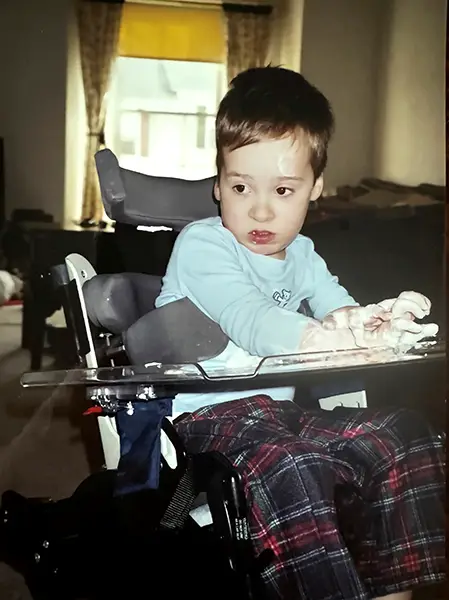
It wasn't until a few years later when Andrew outgrew his first wheelchair and most other strollers designed for smaller children with disabilities that I began to realize how important a properly fitted wheelchair was for Andrew. A wheelchair wasn't just a place for him to sit, it was the only way he could safely access his home, his school, and the outside world. The proper support on the chair allowed Andrew to eat safely, play, communicate, and even use his eyes to see his world in the best way he could. The wheelchair was no longer an unused piece of equipment; it was a key component to Andrew's life.
Through the years we have purchased a few wheelchairs for Andrew. We are fortunate to have a great system and team in place. Here is how we go about getting a new wheelchair for Andrew.
First, we contact Andrew's mobility equipment supplier to request a meeting to discuss a new chair. When Andrew was young, we met at his school building during the day. Now that Andrew is no longer a student, we meet at his physical therapist's office, or at home. Whichever works best for Andrew. I also invite Andrew's private physical therapist, school teacher, or therapists at school to advise us – anyone who knows him!
At this first meeting, the mobility representative asks us a lot of questions. What's working on the current chair? He then checks for Andrew's growth and any kind of changes in his physical being and health. We discuss all the options: seat cushions, wheelchair frame, wheels, supports for Andrews head; chest; feet, etc. We discuss what works for me as Andrew's mom, the foot brakes, handle bars, etc. Does the chair fir on the school bus and in our car? We choose materials, colors, and the tray. The physical therapist checks that the chair helps Andrew the best it can. The team works together to take measurements and prepares the best possible seating solution for Andrew so that he can feel comfortable and is supported.
Next, the PT works on the paperwork along with the equipment representative to justify what Andrew needs for his chair to send to the insurance company. We wait for insurance approval.
We follow up with another appointment so that Andrew can be fitted and have his particular seating system molded to fit his body.
We meet for hopefully the last time when the chair is finished. We all come together and see that everything is in place as we had hoped, and most of all that Andrew is comfortable.

I am appreciative after all these years that Andrew and I have such a great time in place that will ensure that his mobility needs are properly met. I am also grateful that there are many options, tools, and supports for Andrew's mobility so that he and so many like him who face huge hurdles in their lives can face them in an easier way.
About the author
Rachel A. is mom to four children. Her first son was born full term, but with difficulty leading to a life that wasn't what she had prepared for. Rachel has found strength and support from other caregivers of children living with special needs. She hopes to share a little of what she's learned over these 25 years with other families. Rachel lives in Maryland with her husband and four children, dog, cat, and various foster kittens. She loves traveling, especially out west and to Sanibel Island, FL. She also enjoys spending time with her husband and kids, cooking, thrifting, listening to music, and spending time outdoors.
Most of the stories here on LiveQuickie.com were submitted by readers. Do you have a story to tell? We'd love to hear it. Submit your story here.