I have been living with Multiple Sclerosis for 20 years. M.S. is an autoimmune disease that affects the central nervous system. My immune system mistakenly attacks the protective coating around my nerves, known as the myelin sheath. This damage disrupts the signals between my brain and the rest of my body.
For the first ten years after my diagnosis, M.S. did not permanently limit my physical abilities. Shortly after turning 30, however, my mobility changed dramatically and I began using a wheelchair. At that time, I was provided with a power wheelchair that I could drive using my left hand. Because I could no longer use my legs or my right hand, I was placed in a nursing facility where I needed help with daily tasks such as getting dressed, using the bathroom, and transferring into my wheelchair.
Even with those challenges, having a wheelchair that I could operate myself made a meaningful difference. I remember sitting outside the facility feeding squirrels and enjoying the independence that small moment gave me.
Unfortunately, the chair only lasted about a year before it began to fail from constant use. I was then provided a manual wheelchair. Being in a manual wheelchair was incredibly difficult. Anytime I wanted to go somewhere, I had to rely on someone else to push me. As my independence decreased, I began to feel increasingly depressed.
Everything began to change when my neighbor, Cassie, introduced me to her friend Allison, who also used a wheelchair. Allison told me about a program called Vocational Rehabilitation through the Florida Department of Education. Vocational Rehabilitation is designed to help people with disabilities gain access to employment opportunities by providing adaptive equipment and resources.
After several meetings with the program, it was determined that I qualified for a new power wheelchair. During my evaluation with a technician from Custom Mobility, I learned about new technology that would allow me to operate a wheelchair using a Bluetooth headset that responds to head movements. I was excited to try it.
Within a few weeks of training, I was learning how to maneuver my wheelchair using this system. As I became more comfortable with it, I also became happier and more confident. I started navigating throughout the facility and exploring the surrounding neighborhood again. I was even featured in a case story for Sunrise Medical.
With practice and persistence, I was able to move around with much greater ease. I began reintegrating into the community and visiting local stores. Within a few months, I was regularly attending church and participating in church activities. People no longer saw me only as someone who was paralyzed. They saw someone who was capable.
As my confidence grew, I began forming meaningful friendships at the facility. One of those friends, Robert, also used a power wheelchair. He introduced me to Donny, who had seen me driving throughout the facility. We spent a lot of time together and eventually fell in love. What started as a friendship quickly grew into something much deeper. Being able to move independently allowed me to spend time with others, build relationships, and truly be present in my community.
After several months together, we contacted a pastor and held a Celebration of Love ceremony. It was a meaningful moment that reflected how much my life had changed. Not long after, Donny and I were married.
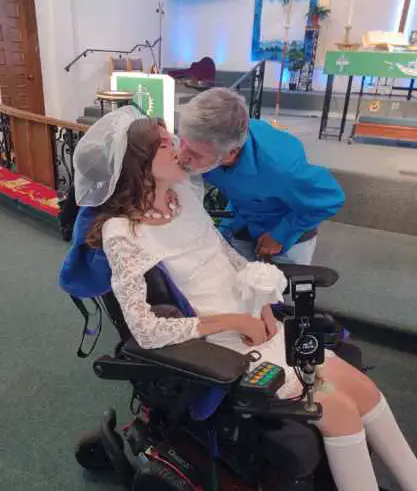
During those moments, I often thought about everything that had led me there. Regaining my mobility gave me the opportunity to reconnect with my community, form relationships, and build a life that once felt out of reach.
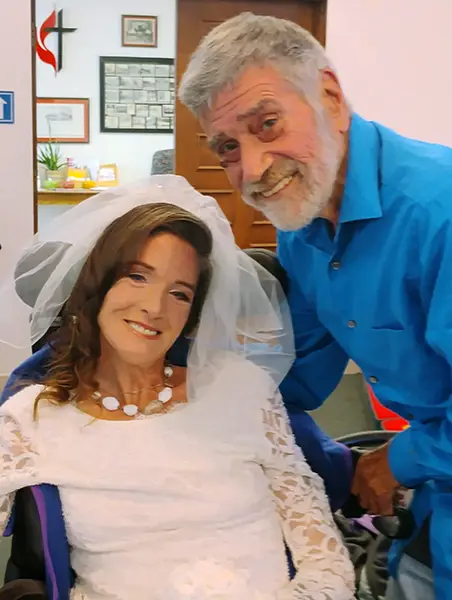
Today, Donny and I are extremely happy together. I feel active, confident, and engaged in the world around me. Thanks to advances in mobility technology made possible by Sunrise Medical, I am once again a participant in my own life.
About the author
Jean Daddis has been living with Multiple Sclerosis (M.S.) for over 20 years. After losing the ability to use her legs and right hand, Jean relied on wheelchair mobility to maintain independence. Through perseverance and the help of assistive technology, she regained the ability to navigate her community and participate more fully in life. Today, Jean shares her story to highlight the impact that mobility technology can have on independence, confidence, and connection.
Most of the stories here on LiveQuickie.com were submitted by readers. Do you have a story to tell? We'd love to hear it. Submit your story here.